
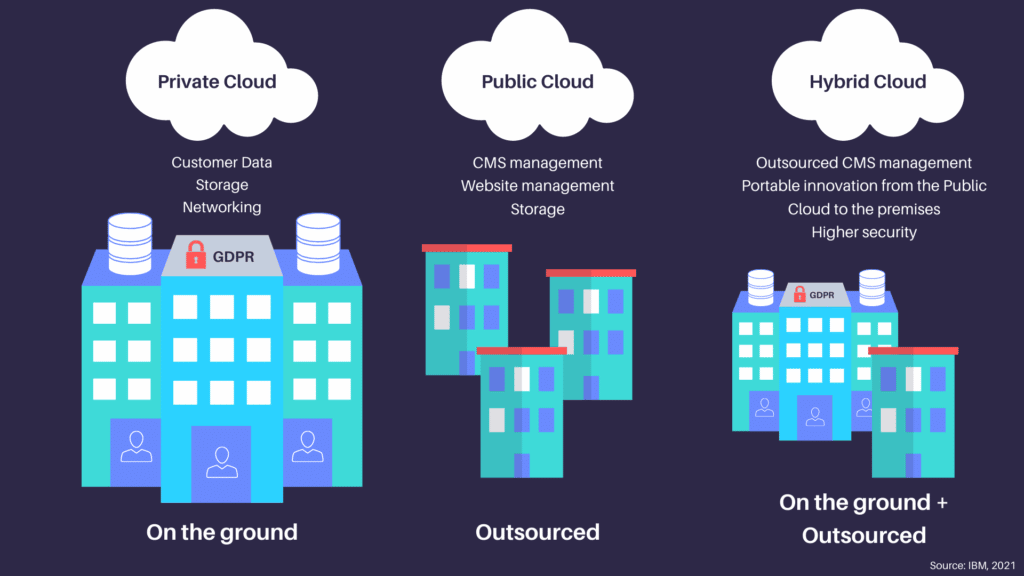
Cloud computing is the backbone of modern business. It powers e-commerce, remote work, and the IT infrastructure for emerging technologies like generative AI and quantum computing.
Empower yourself with the knowledge of cloud architecture, a crucial decision for enterprise success. By comparing private, public, and hybrid cloud models, you can understand how they fit different business needs. Today, these models aren’t isolated; they often work together in a hybrid multi-cloud setup—an IT strategy that combines on-premises infrastructure, private and public clouds, and edge computing, usually leveraging multiple cloud consulting services providers for maximum flexibility and performance.
What is a Public Cloud?
A public cloud is a type of computing in which a cloud provider offers various resources—like applications, virtual machines, and servers—over the Internet. Instead of owning and maintaining their infrastructure, businesses and individuals can rent these services on a subscription or pay-as-you-go basis.
According to a Gartner report, global spending on public cloud services is expected to reach $679 billion by 2027 and could surpass $1 trillion.
Public clouds are multi-tenant environments, meaning multiple users share the same infrastructure. However, each tenant’s data remains separate and secure. Since resources are shared, cloud smart strategy provider can offer services at a much lower cost than if each business managed its IT infrastructure.
Benefits of Public Cloud
- Scalability
Instantly adjust computing resources to handle traffic spikes.
- Cost-Effective
Pay only for what you use, eliminating the need for expensive on-premises hardware.
- Quick Setup
Deploy new servers and applications without worrying about buying or maintaining physical infrastructure.
What is a Private Cloud?
A private cloud is a cloud computing environment dedicated to a single organization. Unlike public clouds, private clouds operate on a single-tenant model, meaning only one company can access the resources. These can be hosted on-site, in a rented data center, or managed by a cloud provider.
Private clouds provide a fortress of security and control, making them ideal for organizations handling sensitive data. Government agencies, for example, often use private clouds to protect classified information or personally identifiable data. According to Gartner, 75% of the global population will have their data protected under modern privacy regulations by 2024.
Businesses using private clouds can implement custom security measures like VPNs, encryption, firewalls, and API keys. They also have more control over data storage locations, ensuring compliance with industry regulations and regional laws—an essential factor for sectors like healthcare, finance, and energy.
Benefits of Private Cloud
- Greater Control
Organizations manage their infrastructure, configurations, and security policies.
- Customization
Tailor hardware and software to meet specific business needs.
- Enhanced Security
Store sensitive data behind private firewalls for better protection against cyber threats.
What is a Hybrid Cloud?
A hybrid cloud, with its blend of public, private, and on-premises infrastructure, offers the flexibility to adapt to changing needs. This approach allows businesses to move workloads between environments as needed, optimizing for performance, security, and cost.
For example, a company can use public cloud services to handle sudden traffic surges while keeping sensitive workloads in a private cloud. This technique, called cloud bursting, ensures seamless operations without overloading private infrastructure—perfect for e-commerce sites managing Black Friday sales or streaming services handling peak usage times.
Previously, hybrid clouds focused on moving workloads from on-premises data centers to private clouds before connecting them to public clouds. Now, they emphasize workload portability, making it easier to run applications efficiently across different environments.
Hybrid cloud environments also support microservices, a modern approach to software development in which applications are broken down into smaller, independent components. Tools like Kubernetes help automate the deployment and scaling of these applications, allowing businesses like Uber to improve their ride-hailing and food-delivery services continuously.
Additionally, hybrid cloud models provide flexibility for industries that rely on IoT and edge computing. In manufacturing, for instance, a hybrid cloud can analyze real-time factory data, predict maintenance needs, and minimize downtime—all while ensuring fast and reliable processing.
Benefits of Hybrid Cloud
Flexibility
Choose the best environment for each workload, balancing performance and security.
Faster Development
Supports agile and DevOps practices, accelerating software delivery.
Supports Digital Transformation
Enables businesses to process massive data sets and adopt AI/ML technologies for innovation.
Choosing the Right Cloud Strategy
Selecting the right cloud model is a crucial decision that requires careful consideration of several key factors:
Business Goals
The cloud model should align with your organization’s objectives, ensuring flexibility, scalability, and cost-effectiveness.
Security & Compliance
Consider the sensitivity of your data and industry regulations. If security is a top priority, a private cloud might be the best choice, whereas a hybrid model can offer both security and flexibility.
Budget Considerations
Compare pricing structures like pay-as-you-go and subscription-based models. Be sure to factor in hidden costs such as data transfer fees and maintenance expenses.
Scalability Needs
Assess how your business is expected to grow and whether your workloads fluctuate. Choose a cloud model that can scale effortlessly with your evolving needs.
Infrastructure Control
Determine the level of control you need over configurations, security policies, and hardware. A public cloud offers ease of management, while a private cloud gives you complete autonomy.
Conclusion
In today’s fast-paced and complex business landscape, a well-planned approach to cloud strategy, whether public, private, or hybrid, is essential to drive real value. Each cloud model has unique security and management requirements, so choosing which applications to move to the cloud is crucial. This approach helps businesses optimize IT resources, enhance agility, and foster innovation. You can seek help from an expert to choose which cloud